
TBF means “To Be Fair.” It’s a short and informal way to introduce a balanced opinion, clarification, or justification in text messages and online chats.
People use TBF when they want to show fairness, add another side of the story, or soften criticism in conversations.
TBF Mean in Text: Full Guide to Meaning, Usage & Examples
If you’ve seen “tbf” in a message and wondered what it means, you’re not alone. This short abbreviation appears everywhere — from SMS and WhatsApp chats to Snapchat captions and TikTok comments.
In this detailed guide, you’ll learn:
- TBF meaning in text
- TBF slang meaning
- TBF meaning on Snapchat
- What does TBF mean in chat
- Real-life examples
- Grammar role and tone
- Who uses it most
- Similar abbreviations (with comparison table)
- FAQs based on real search intent
Let’s break it down clearly and simply.
TBF Full Form and Basic Meaning
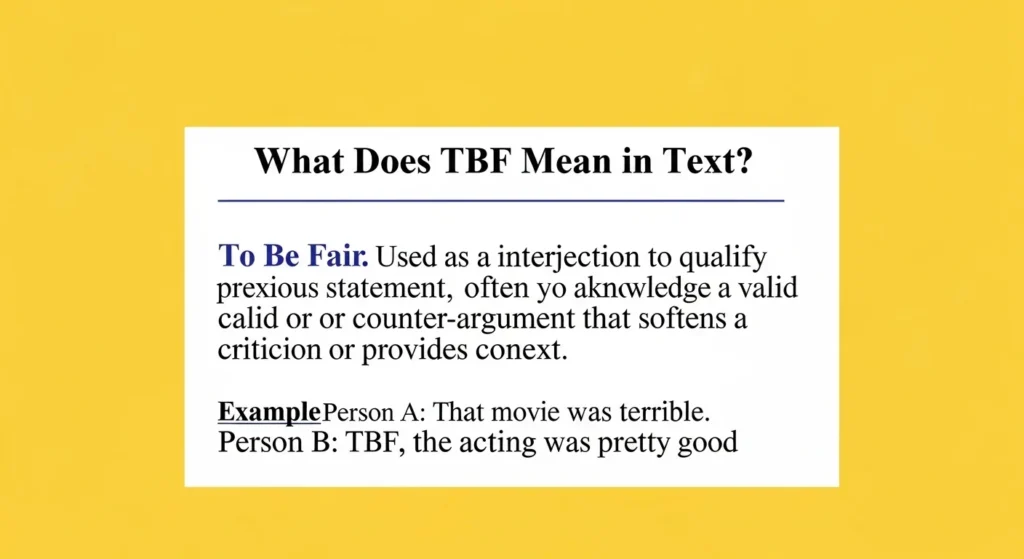
TBF stands for “To Be Fair.”
It’s used when someone wants to:
- Present a balanced opinion
- Defend someone
- Add a fair perspective
- Correct a misunderstanding
- Soften a strong statement
Simple Example:
“Tbf, he did try his best.”
The person is adding fairness to the discussion.
TBF Meaning in Text Messages (SMS & WhatsApp)
In text messages, TBF usually appears at the beginning of a sentence.
It signals that the sender wants to be reasonable or balanced.
Example in SMS:
- “Tbf, the movie wasn’t that bad.”
- “TBF, you didn’t tell her the full story.”
- “Tbf, I was late because of traffic.”
It helps avoid sounding rude or overly critical.
TBF Meaning on Snapchat
On Snapchat, TBF is commonly used:
- In captions
- In private chats
- In story replies
It usually introduces a fair opinion about a situation.
Snapchat Example:
“Tbf, that filter actually looks good on you.”
Here, the speaker might have criticized before but now adds balance.
TBF Meaning on Instagram & TikTok
On Instagram and TikTok, TBF appears in:
- Comment sections
- Reaction posts
- Debate threads
Example on TikTok:
“Tbf, she explained everything clearly in part 2.”
It’s often used during online debates to show fairness.
Is TBF Formal or Informal?
TBF is informal.
It’s suitable for:
- Friends
- Social media
- Casual chats
- Online comments
It is not recommended for:
- Job emails
- Academic writing
- Official documents
Instead of “TBF,” you would write the full phrase:
“To be fair…”
TBF Slang Meaning Explained
TBF is considered internet slang because:
- It’s shortened for speed
- It’s mostly used in digital communication
- It’s popular among younger users
However, unlike aggressive slang, TBF is polite slang.
It doesn’t insult anyone.
It usually makes conversations more balanced.
Grammar Role of TBF
Understanding the grammar role helps you use it correctly.
1️⃣ Part of Speech
TBF functions as a sentence adverbial phrase.
It modifies the entire sentence by introducing fairness.
Full form:
“To be fair…”
Abbreviation:
“Tbf…”
2️⃣ Sentence Position
Most common position:
✔ At the beginning of a sentence
“Tbf, he warned us.”
Sometimes in the middle:
✔ After a pause
“It was boring, tbf.”
Rarely at the end:
“He did apologize, tbf.”
3️⃣ Tone
TBF can:
- Soften criticism
- Add reason
- Reduce conflict
- Show maturity
Without TBF:
“You’re wrong.”
With TBF:
“Tbf, I think you misunderstood.”
Notice how it sounds calmer.
Real-Life Texting Examples of TBF
Here are realistic conversations showing how people use TBF.
Example 1 – Defending a Friend
A: “Why didn’t he show up?”
B: “Tbf, he had a family emergency.”
Example 2 – Movie Debate
A: “That movie was terrible.”
B: “Tbf, the acting was actually good.”
Example 3 – Relationship Chat
A: “She overreacted.”
B: “Tbf, you forgot her birthday.”
Example 4 – School Discussion
A: “The teacher is strict.”
B: “Tbf, the class is very noisy.”
Example 5 – Workplace Chat
A: “The manager was rude.”
B: “Tbf, he’s under a lot of pressure.”
These examples show how TBF adds balance.
Who Commonly Uses TBF?
Age Group
Most common among:
- Teenagers (13–19)
- Young adults (18–30)
- Online communities
Older adults use it less frequently.
Region
TBF is widely used in:
- United States
- United Kingdom
- Canada
- Australia
- South Asia (especially in English chats)
It’s popular in English-speaking digital culture.
Platforms Where TBF Is Popular
- Snapchat
- TikTok
- Twitter (now X)
It appears mostly in casual discussions and comment threads.
TBF vs Similar Internet Slang (Comparison Table)
Many users confuse TBF with other abbreviations. Here’s a clear comparison:
| Abbreviation | Full Form | Meaning | Tone | Example |
|---|---|---|---|---|
| TBF | To Be Fair | Adding balance | Polite | “Tbf, he tried.” |
| TBH | To Be Honest | Expressing honesty | Direct | “Tbh, I don’t like it.” |
| IMO | In My Opinion | Personal opinion | Neutral | “IMO, it’s overpriced.” |
| BTW | By The Way | Changing topic | Casual | “BTW, call me later.” |
| IDK | I Don’t Know | Uncertainty | Casual | “Idk what happened.” |
Key Difference:
- TBF = Fairness
- TBH = Honesty
- IMO = Personal opinion
People often search:
“Is TBF the same as TBH?”
No, they are different in tone and purpose.
What Does TBF Mean in Chat?
When someone asks:
What does TBF mean in chat?
The answer is simple:
It means “To Be Fair”, and it introduces a balanced or reasonable point.
In heated chats, it often reduces tension.
When Should You Use TBF?
Use TBF when:
- You want to defend someone
- You want to present another side
- You want to soften criticism
- You want to sound reasonable
Avoid it when:
- Writing formal emails
- Submitting academic work
- Talking to clients professionally
Short Experience-Based Insight
From real online conversations, TBF is often used during disagreements.
For example:
In group chats, one person criticizes someone. Another person replies with “Tbf…” and explains the situation.
It acts like a social cushion.
Instead of attacking, it balances.
This is why TBF is popular — it keeps conversations calmer.
Psychological Impact of Using TBF
Using TBF can:
- Make you sound mature
- Show emotional intelligence
- Reduce conflict
- Build trust in discussions
It signals:
“I’m not being biased.”
That small phrase changes tone significantly.
Common Mistakes When Using TBF
❌ Using it in formal emails
Wrong:
“Tbf, the contract was unclear.”
Correct:
“To be fair, the contract was unclear.”
❌ Overusing it
If you start every message with TBF, it may sound repetitive.
Use it only when necessary.
❌ Misunderstanding Tone
TBF is not sarcastic by default.
But in some contexts, it can be used sarcastically.
Example:
“Tbf, you always forget.”
This might sound passive-aggressive depending on tone.
SEO-Friendly FAQs About TBF
1. What does TBF mean in text?
TBF means “To Be Fair.” It is used to introduce a balanced or reasonable opinion in text messages and online chat.
2. What is TBF slang meaning?
The slang meaning of TBF is simply the abbreviated form of “To Be Fair,” used informally in digital communication.
3. What does TBF mean on Snapchat?
On Snapchat, TBF means “To Be Fair.” It is often used in captions or replies to show fairness in discussions.
4. Is TBF rude?
No, TBF is not rude. It usually softens criticism and makes conversations more balanced.
5. Is TBF the same as TBH?
No.
TBF means “To Be Fair.”
TBH means “To Be Honest.”
They serve different purposes in conversation.
6. Can adults use TBF?
Yes, but it’s mostly used by younger people in informal settings.
7. Should I use TBF in professional emails?
No. Use the full phrase “To be fair” instead.
Final Summary: How to Use TBF Correctly
Let’s recap everything clearly.
TBF means “To Be Fair.”
It is:
- Informal
- Polite
- Used in chats and social media
- Common among young people
It helps:
- Add balance
- Reduce conflict
- Defend someone
- Sound reasonable
Best Usage Tip
If you’re texting friends or commenting online, TBF is perfectly fine.
If you’re writing something professional, use the full phrase instead.
Quick Usage Formula
✔ Casual chat → Use “Tbf”
✔ Social media comment → Use “TBF”
✔ Formal writing → Use “To be fair”
If you ever see “tbf” in a message, now you know exactly what it means — and how to use it confidently.