
The tilde (~) is a small wavy symbol often seen in text messages, social media posts, and online chats. While it started as a punctuation mark in writing, it has evolved into a playful and expressive tool in digital communication. People use it to convey tone, sarcasm, or approximation in casual conversations. Understanding its meaning can help you interpret messages more accurately.
In texting and online slang, the tilde adds subtle nuance that words alone sometimes can’t. It’s common on platforms like WhatsApp, Snapchat, Instagram, and TikTok. From softening statements to showing irony or playfulness, the tilde gives personality to messages. In this article, we’ll explore the tilde meaning in text, how to use it, and real-life examples for everyday chats.
What Does Tilde Mean in Text Messages?
In texting and online chats, the tilde (~) is often used to:
- Indicate approximation or uncertainty:
“I’ll be there in ~10 minutes” - Add a playful or sarcastic tone:
“Yeah, that was ~amazing…” - Softly emphasize a word or phrase without being harsh:
“I’m a little ~tired today.”
Unlike formal writing, the tilde in text is informal and meant to convey emotion, mood, or nuance rather than strict grammar.
Tilde Slang Meaning
In online slang, the tilde has evolved into a tone marker. It can suggest:
- Playfulness – softening a statement to make it feel friendly
- Sarcasm or irony – hinting that a statement is not entirely serious
- Flirtation or teasing – commonly used in casual messaging
Example in chat:
- “I guess you’re ~the best at this 😏” → playful sarcasm
- “Sure, I’ll help you ~later” → softening a delay or excuse
Full form or acronym?
The tilde is not an acronym; it’s purely a symbol whose meaning depends on context.
Tilde Meaning on Snapchat, Instagram, and TikTok
Different platforms use the tilde slightly differently:
- Snapchat – often used in captions or messages to add a casual or ironic tone
“New outfit ~🔥” - Instagram – used in bios, comments, or captions for emphasis or style
“Vacation vibes ~🌴” - TikTok – can signal sarcasm in text overlays or comments
“I’m sooo good at dancing ~😂”
On these platforms, the tilde helps convey personality, tone, or subtle humor.
Real-Life Texting Examples of Tilde Usage
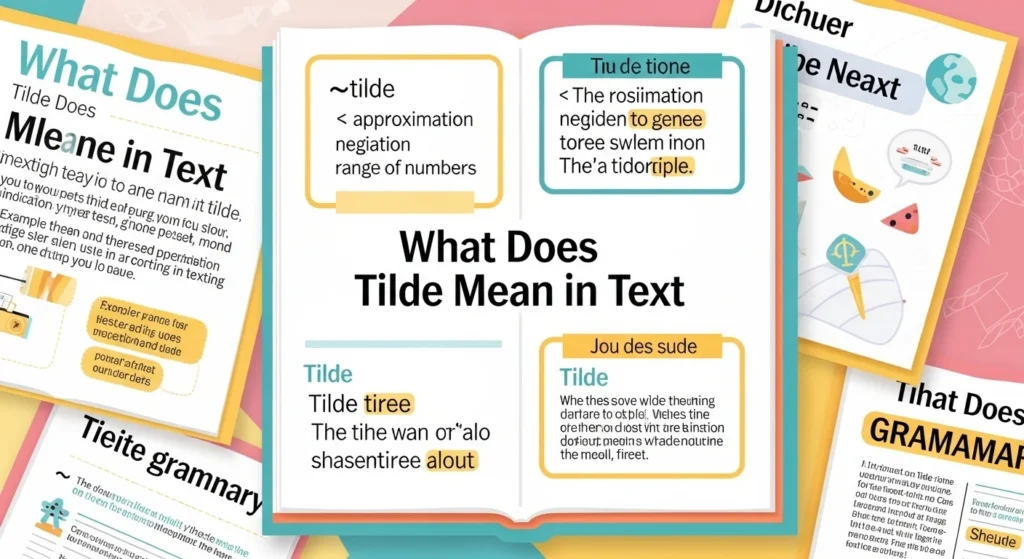
Here are some real-world texting scenarios:
- Casual conversation
“I might come to the party ~8 pm” → approximate time - Softening a request
“Can you ~send me that file?” → polite, non-demanding tone - Playful sarcasm
“Yeah, your cooking was ~amazing” → teasing friend - Flirty tone
“You look ~cute today” → light, teasing compliment
These examples show how versatile the tilde can be in casual conversation.
Grammar Role of the Tilde in Text
Although the tilde is primarily informal, it can play subtle grammatical and stylistic roles:
- Part of speech: Symbol, not a word
- Sentence position: Usually follows the word or phrase it modifies
- Tone: Softening, playful, ironic, or sarcastic
It’s important to note that in formal writing, the tilde is rarely used this way; it’s a feature of digital communication style, not academic grammar.
Tilde vs. Similar Symbols
People often confuse the tilde (~) with other symbols. Here’s a quick comparison table:
| Symbol | Name | Usage in Text | Example |
|---|---|---|---|
~ | Tilde | Approximation, sarcasm, playful tone | “I’ll be there in ~10 min” |
- | Hyphen | Connects words, compound terms | “Well-known author” |
_ | Underscore | Style, usernames, emphasis | “my_name_here” |
^ | Caret | Rarely used in casual chat, more math | “2^3 = 8” |
… | Ellipsis | Pauses, unfinished thoughts | “I guess we can… maybe” |
This table helps clarify the tilde meaning in text versus other commonly seen symbols.
Who Commonly Uses the Tilde?
The tilde is most popular among:
- Younger users (teens and young adults, 13–30)
- Social media active users on Snapchat, Instagram, TikTok
- Texting platforms like WhatsApp, iMessage, Discord
Regionally, it’s more prevalent in Western online communities, but global social media adoption has made it widely recognized.
FAQs About “What Does Tilde Mean in Text”
Q1: What does tilde mean in chat?
A: In chat, a tilde (~) adds playfulness, sarcasm, or approximation. It softens statements without changing the core meaning.
Q2: Is tilde formal or informal?
A: The tilde in text is informal. It’s widely used in casual messages and social media, not academic writing.
Q3: Can tilde change the tone of a sentence?
A: Yes! Adding a tilde can make a statement feel friendly, sarcastic, or teasing.
Q4: How is tilde used on Snapchat?
A: Users put it after words in captions or messages to convey subtle emotion or style.
Q5: Are there other slang uses for tilde?
A: In some online communities, it indicates irony, sarcasm, flirtation, or uncertainty.
How People Really Use Tilde in Conversations
From experience, the tilde acts as a tone marker in texting. People rarely overthink it—they just use it instinctively to:
- Make a message feel lighter or less demanding
- Add humor or teasing without extra words
- Signal uncertainty or approximation
For example: “I’ll try to finish it ~tomorrow” feels softer and more polite than “I’ll finish it tomorrow.”
Usage Tips for Tilde in Text
- Use it sparingly to avoid confusion
- Combine with emojis for tone clarity
- Ideal for informal texting, social media posts, and captions
- Avoid in formal emails or academic writing
- Experiment with placement to achieve the desired nuance
Summary
The tilde (~) in text is more than a wavy line. In modern online slang, it conveys playfulness, sarcasm, flirtation, or approximation. Common on Snapchat, Instagram, TikTok, and WhatsApp, it’s used by younger audiences to add subtle nuance to their messages.
Key takeaways:
- Informal symbol, not an acronym
- Softens tone and conveys emotion
- Appears after words or phrases
- Works well with emojis
- Avoid in formal communication
By understanding the tilde meaning in text, you can enhance your online messaging, make your tone clearer, and add personality to digital conversations.