
If you’ve ever received a message that says, “Goodnight, boo ❤️” and paused for a second, you’re not alone.
Many people search “what does boo mean in text” because the word feels affectionate — but also slightly confusing. Is it romantic? Friendly? Flirty? Or something else entirely?
The truth is, “boo” can mean different things depending on who’s saying it, how it’s said, and the relationship behind it. In modern texting culture, tone carries everything.
Let’s break it down clearly, naturally, and in a way that actually makes sense in real life.
What Does Boo Mean in Text – Quick Meaning
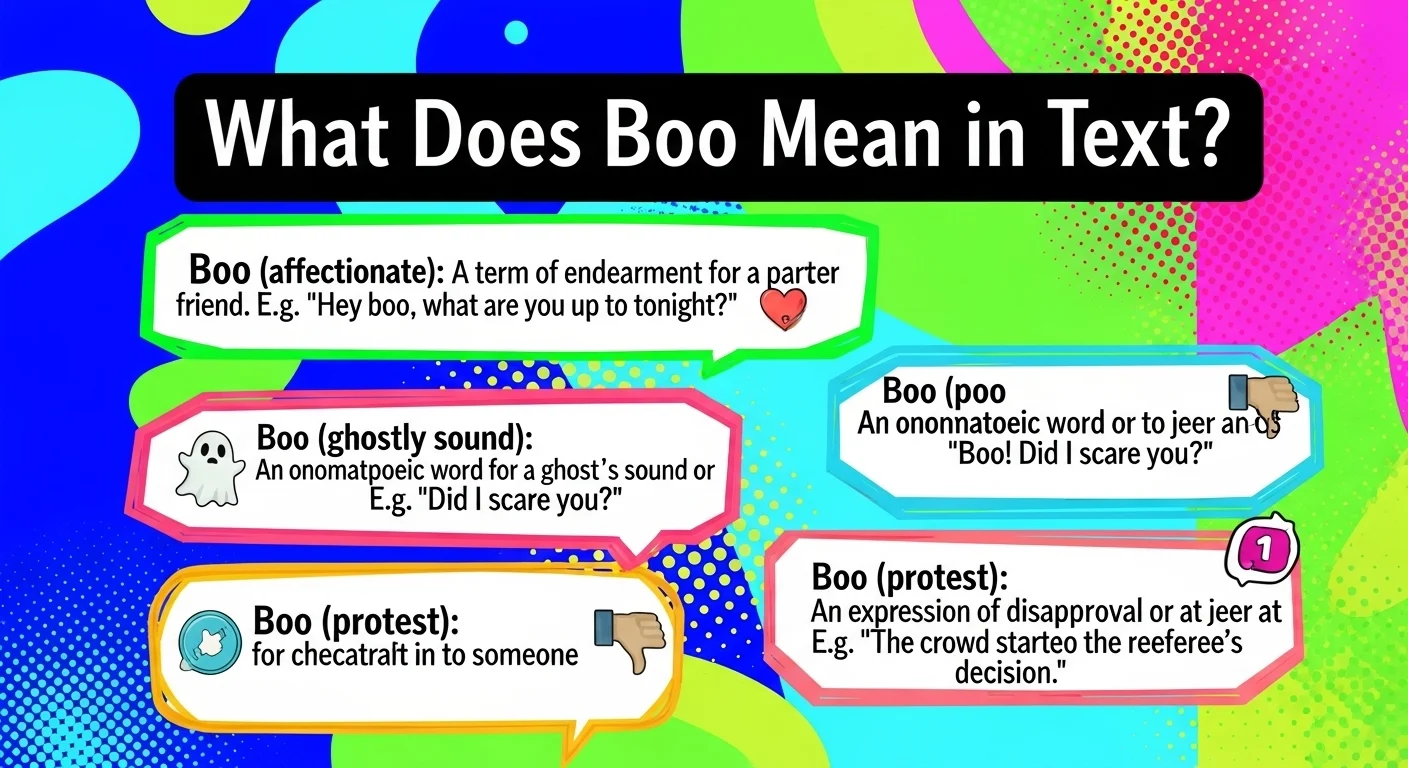
In texting, “boo” is usually a term of affection.
It commonly means:
- A romantic partner
- Someone you care about deeply
- A crush or love interest
- Occasionally, a very close friend
Simple definition:
“Boo” = someone special to you.
Example texts:
“Miss you, boo.”
“What are you doing tonight, boo?”
“Good morning, boo 😘”
In most cases, it signals closeness and emotional warmth.
But that’s just the surface.
Origin & Background of “Boo”
The word didn’t start with texting.
“Boo” as a romantic nickname traces back to African American Vernacular English (AAVE). It gained mainstream popularity in the 1990s, especially through R&B and hip-hop music.
One major cultural moment came with the song My Boo by the Ghost Town DJs, which cemented the term as a romantic nickname in pop culture.
Later, artists like Usher and Alicia Keys released their duet My Boo, pushing the word even further into mainstream language.
By the early 2010s, social media platforms like Instagram and Twitter helped “boo” evolve into a casual digital term of endearment.
Now, it lives comfortably in:
- WhatsApp chats
- Instagram captions
- TikTok comments
- Snap streaks
- Late-night “wyd boo?” messages
Language adapts fast online — and “boo” adapted beautifully.
Real-Life Conversations (How It’s Actually Used)
Let’s look at how “boo” shows up in real conversations.
1. WhatsApp (Romantic)
Person A: You reached home safe?
Person B: Yes boo, just got in ❤️
Person A: Good. Text me when you wake up.
This feels intimate and caring.
2. Instagram DM (Flirty)
Person A: Why you looking that good in your story, boo?
Person B: Stoppp 😭
Here, it’s playful and slightly teasing.
3. TikTok Comment (Light & Casual)
Person A: Boo really thought we wouldn’t notice that filter 😂
In this case, “boo” isn’t romantic. It’s a humorous, slightly dramatic way to address someone.
4. Text Message (Close Friends)
Person A: Boo, I need advice.
Person B: I’m listening. What happened?
Among close friends, it can simply signal emotional closeness.
Context changes everything.
Emotional & Psychological Meaning
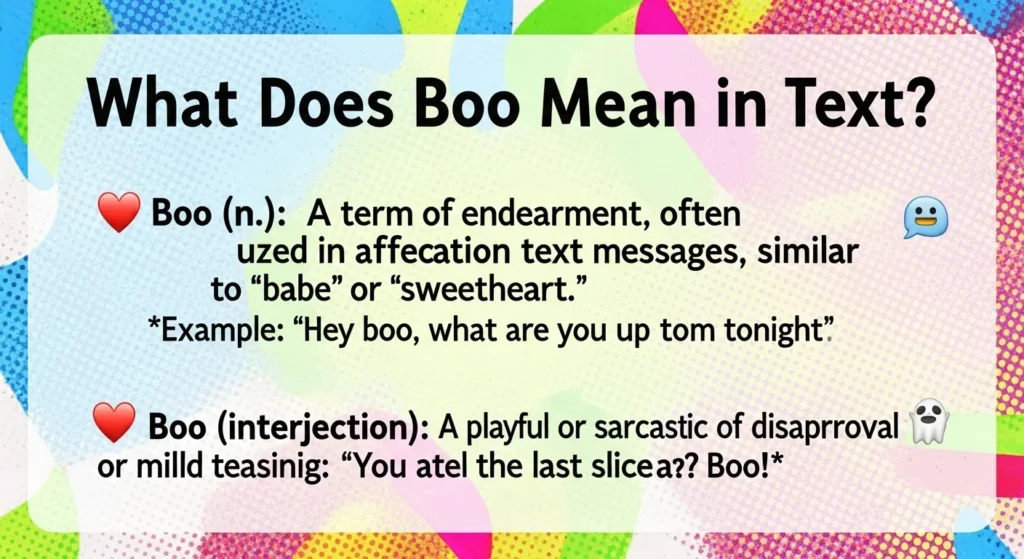
“Boo” expresses warmth, attachment, and emotional security.
When someone uses it, they’re usually signaling:
- Comfort
- Familiarity
- Romantic interest
- Soft affection
- Emotional closeness
Psychologically, pet names like “boo” create intimacy. They separate your connection from the rest of the world.
I once worked with a student who asked why her boyfriend stopped calling her “boo” and started using her real name more often. To her, that shift felt emotionally distant — even though nothing dramatic had happened.
That’s how powerful small words can be.
Pet names aren’t just labels. They’re emotional signals.
Usage in Different Contexts
Social Media
On Instagram or TikTok, “boo” can be:
- Romantic (“My forever boo ❤️”)
- Sarcastic (“Okay boo, whatever you say”)
- Friendly (“You look good boo!”)
Tone often depends on emojis and punctuation.
Friends & Relationships
In romantic relationships, it’s deeply affectionate.
Between friends, especially among younger generations, it can be playful and supportive.
Work / Professional Settings
Avoid it.
Calling a coworker “boo” in a professional email would feel inappropriate or unprofessional.
Example to avoid:
❌ “Thanks for the report, boo.”
That crosses boundaries.
Casual vs Serious Tone
- “Love you boo” → Soft and sincere
- “Okay boo 🙄” → Slightly sarcastic
- “Whatever boo” → Dismissive
Same word. Very different energy.
When NOT to Use It
There are moments where “boo” can backfire.
Avoid using it:
- In professional communication
- With someone you barely know
- In formal academic or workplace settings
- With someone from a culture that values formal address
- During serious conflict conversations
For example, saying “Calm down, boo” during an argument might feel dismissive.
Tone matters more than the word itself.
Common Misunderstandings
Here’s what people often get wrong:
1. Thinking it always means “girlfriend/boyfriend.”
Not always. Sometimes it’s just playful slang.
2. Assuming it’s childish.
It depends on delivery and relationship maturity.
3. Confusing it with the ghost sound “boo.”
Completely different meaning.
4. Ignoring sarcasm.
“Sure, boo” can sound supportive — or passive-aggressive.
Texting lacks vocal tone, so interpretation can vary widely.
Comparison Table
| Word | Meaning | Tone | Usage Level |
|---|---|---|---|
| Boo | Romantic/affectionate nickname | Soft, warm | Intimate |
| Babe | Romantic partner | Common, mainstream | Romantic |
| Bae | Before anyone else | Trendy | Casual |
| Love | Deep affection | Strong | Serious |
| Bro | Friend | Casual | Platonic |
| Sweetie | Caring tone | Gentle | Friendly or romantic |
Key Insight:
“Boo” sits between playful and intimate. It’s softer than “love” but warmer than “bro.”
Variations of “Boo” (10 Types)
- My boo – My romantic partner.
- Hey boo – Friendly or flirty greeting.
- Boo thang – Casual love interest.
- Lil boo – Younger partner or playful tone.
- Boo boo – Extra affectionate, sometimes teasing.
- Future boo – Someone you’re romantically interested in.
- Main boo – Primary romantic partner.
- Side boo – Secret or unofficial partner (can imply drama).
- Work boo – Work crush.
- Internet boo – Online romantic interest.
Each variation changes the emotional intensity slightly.
How to Respond When Someone Calls You Boo
Your reply depends on your relationship.
Casual Replies
- “Hey you 😊”
- “What’s up?”
Funny Replies
- “Yes, ghost speaking 👻”
- “Who you calling boo?”
Mature Replies
- “That’s sweet.”
- “I like when you call me that.”
Respectful Replies (If You’re Not Interested)
- “Hey! But maybe just use my name.”
- “Let’s keep it friendly 😊”
Your response sets the boundary.
Regional & Cultural Usage
Western Culture
In the U.S., it’s widely accepted as romantic slang.
Among Gen Z and Millennials, it’s normal and affectionate.
Asian Culture
In some Asian countries, English pet names feel trendy but may sound overly intimate if used too quickly.
Context and relationship stage matter more.
Middle Eastern Culture
Public displays of romantic slang can feel too forward in conservative communities.
Private usage is more common than public social media captions.
Global Internet Culture
Online, “boo” has softened. It can even be used humorously toward strangers in comment sections.
Example:
“Okay boo, we see you!”
Generational Differences
Gen Z: Uses it casually, sometimes ironically.
Millennials: More romantic usage.
Older generations: May see it as youthful slang.
Language evolves with age and digital exposure.
Is It Safe for Kids?
Generally, yes.
“Boo” is not inappropriate by itself. It simply expresses affection.
However, context matters. If children use it romantically at a very young age, parents may want to guide conversations about boundaries and emotional maturity.
The word itself isn’t harmful — the relationship behind it is what matters.
FAQs
1. Does boo always mean boyfriend or girlfriend?
No. It usually implies affection but can also be playful or friendly.
2. Is calling someone boo flirting?
Often yes, but not always. Tone and context decide.
3. Can friends call each other boo?
Yes, especially close friends.
4. Is boo outdated slang?
Not at all. It’s still widely used in texting and social media.
5. Is it disrespectful to call someone boo?
It can be if the relationship doesn’t support that level of familiarity.
6. What does “my boo” mean?
It strongly implies romantic attachment.
7. Why did someone stop calling me boo?
It could signal emotional distance — or simply a change in texting style.
Conclusion
So, what does boo mean in text?
At its core, it’s a small word with big emotional energy.
It signals affection, closeness, and a sense of “you’re special to me.” But like all digital language, it depends on context, tone, and relationship depth.
Used thoughtfully, it can strengthen emotional connection.
Used carelessly, it can confuse or even create distance.
The key is awareness.
If someone calls you “boo,” pay attention not just to the word — but to the feeling behind it.
That’s where the real meaning lives.