
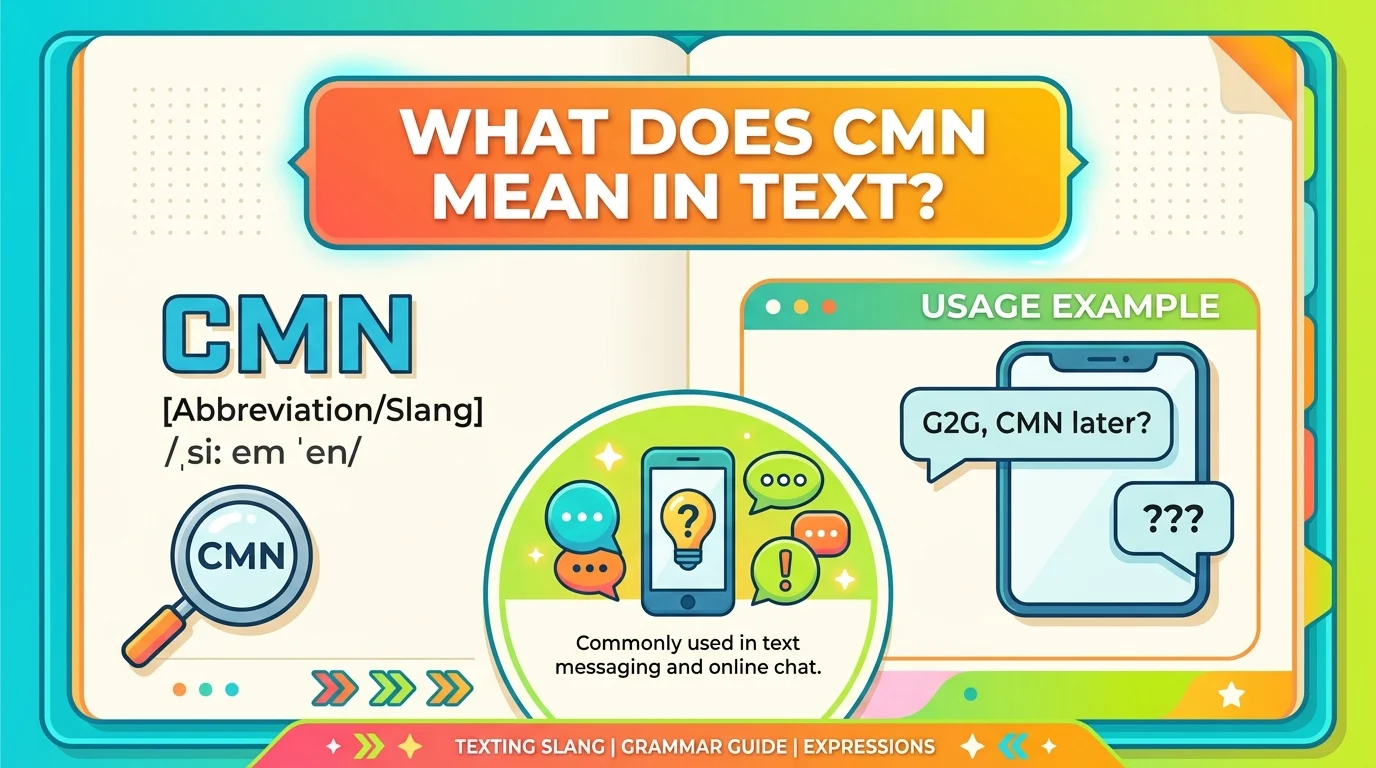
If you’ve ever seen someone type “cmn” in a chat and felt completely lost, you’re not alone. In today’s fast-moving digital conversations, even three letters can carry multiple meanings depending on context, tone, and platform.
People search “what does cmn mean in text” because they usually encounter it in confusing situations—maybe in WhatsApp chats, Instagram comments, or even travel-related posts. And the real problem? It doesn’t have just one fixed meaning.
Sometimes it means “come on”, sometimes it connects to airport codes, sometimes it appears as a shorthand in professional or technical contexts. This flexibility is exactly what makes it both useful and confusing.
In this guide, we’ll break down every meaning of CMN in a real-world, human way so you never misread a message again.
CMN Meaning in Text – Quick Meaning
In texting, the most common meaning of CMN is:
👉 “Come on”
It’s used to express emotion, urgency, disbelief, or encouragement.
Common uses:
- “CMN bro, hurry up!”
- “CMN, that’s not fair!”
- “CMN let’s go already!”
Emotional tone examples:
- “CMN 😂 you’re joking right?”
- “CMN we’re going to be late!”
In short, CMN = a fast, emotional version of come on used in casual digital conversations.
Origin & Background of CMN
CMN didn’t originate as a formal abbreviation. It evolved naturally from texting culture.
As messaging apps grew, people started shortening phrases to type faster. “Come on” became:
- C’mon
- Cmon
- CMON
- CMN (less common but still used)
Social media platforms like TikTok, Snapchat, and Instagram made these abbreviations even more popular. People now prefer speed over grammar in casual chats.
Over time, CMN also picked up secondary meanings depending on industries like aviation, medicine, and geography.
Real-Life Conversations Using CMN
📱 WhatsApp Chat
Person A: I’m still getting ready
Person B: CMN bro, we’re already late 😭
📸 Instagram DM
Person A: I think he ignored my message
Person B: CMN don’t overthink it, maybe he’s busy
🎵 TikTok Comment Section
User 1: This trend is so cringe
User 2: CMN let people enjoy things 😂
💬 Casual Text Message
Person A: I don’t feel like going
Person B: CMN, you promised yesterday!
These conversations show how CMN carries emotion, urgency, and casual pressure in modern communication.
Emotional & Psychological Meaning of CMN
CMN is more than just slang—it reflects emotional intensity in short form.
People use it when they want to:
- Push urgency without sounding too serious
- Express frustration in a light tone
- Encourage someone casually
- React emotionally without typing long sentences
Real-life scenario:
Imagine your friend is delaying a trip you’ve been planning for weeks. Instead of typing a long message, you simply say:
“CMN, I’ve been waiting all week!”
It carries impatience, excitement, and friendliness—all at once.
This shows how modern communication values emotion over structure.
Usage in Different Contexts
1. Social Media
Used in comments and replies to show quick reactions:
- “CMN this is hilarious 😂”
- “CMN drop the full video!”
2. Friends & Relationships
Very common among close friends:
- “CMN pick up the phone”
- “CMN I miss you”
3. Work / Professional Settings
Rarely used in formal communication. Avoid it in emails or meetings.
4. Casual vs Serious Tone
- Casual: very common and acceptable
- Serious: can sound rude or unprofessional
When NOT to Use CMN
Even though CMN is popular, there are situations where it doesn’t belong:
- Formal emails or workplace chats
- Talking to elders or authority figures
- Sensitive emotional conversations
- Academic or professional writing
Using it in the wrong place can make your tone seem impatient or disrespectful.
Common Misunderstandings About CMN
Many people misinterpret CMN because:
- They think it is always “CNN” (news channel confusion)
- They assume it’s a typo
- They don’t understand context-based slang
- They confuse it with airport or medical abbreviations
Without context, CMN can feel meaningless—but in reality, it’s highly situational.
Comparison Table
| Term | Meaning Intent | Usage Intent | Example Intent | Comparison Insight |
|---|---|---|---|---|
| CMN | “Come on” in texting | Express emotion or urgency | “CMN bro hurry up” | Casual slang vs formal language |
| How to Use CMN | Informal expression | Used in chats and comments | Friends texting | Not for professional use |
| Examples of CMN | Real chat usage | Emotional reactions | “CMN seriously?” | Depends on tone |
| CMN vs CNN | Slang vs media brand | Different contexts | CMN = chat, CNN = news | Often confused due to similarity |
Key Insight
CMN is purely context-driven slang, while similar-looking abbreviations often belong to completely different domains like media or travel.
Variations / Types of CMN (8–10 Forms)
- CMN meaning “Come on” in text
Used to show urgency or emotion. - CMN abbreviation slang
Informal shortcut in chats. - CMN in chat
Quick reaction in messaging apps. - C’mon variant
More common spelling of the same phrase. - Cmon shorthand
Faster texting version. - CMN emotional slang
Expresses frustration or excitement. - CMN internet abbreviation
Used in social media replies. - CMN casual tone usage
Friendly pressure or encouragement. - CMN texting style
Used for fast communication. - CMN reaction word
Short emotional response in conversations.
How to Respond When Someone Uses CMN
😊 Casual Replies
- “Haha okay, I’m coming!”
- “Give me 2 mins!”
😂 Funny Replies
- “CMN yourself first 😆”
- “Relax coach, I’m on my way!”
🧠 Mature Replies
- “I understand, I’ll be there soon.”
- “Got it, leaving now.”
🙏 Respectful Replies
- “Sorry for the delay, I’m coming.”
- “Thanks for waiting, I’m on my way.”
Regional & Cultural Usage
Western Culture
Common in texting and social media slang.
Asian Culture
Used mainly among younger generations in casual chats.
Middle Eastern Culture
Less formal usage, mostly among youth online.
Global Internet Usage
Widely understood due to meme culture and TikTok influence.
Gen Z vs Millennials
- Gen Z: uses CMN naturally in chats
- Millennials: more likely to type full phrases
Is CMN Safe for Kids?
Yes, CMN is generally safe because it is just slang for “come on.”
However, kids should understand context—using it in the wrong setting (like school or formal writing) may be inappropriate.
FAQs
What does CMN stand for?
CMN most commonly stands for “Come on” in informal digital communication. It is a shortened slang form used to express emotion or urgency in chats.
What does CMN mean in texting?
In texting, CMN usually means “come on.” People use it to show frustration, encouragement, or excitement in casual conversations.
What is CMN short for?
CMN is short for “come on.” It is a fast typing version commonly used on social media and messaging apps.
What do we mean in texting?
In texting, “we” simply refers to a group including the speaker. It is used to show shared actions, plans, or feelings with others.
Is CMN rude?
CMN is not always rude, but tone matters. It can sound impatient if used sharply, but friendly in casual chats.
Is CMN the same as C’mon?
Yes, CMN and C’mon generally mean the same thing. Both are informal ways of saying “come on.”
Where is CMN commonly used?
CMN is mostly used in WhatsApp, Instagram, Snapchat, and TikTok. It appears in casual chats, comments, and quick reactions.
Can CMN have different meanings?
Yes, in some contexts CMN can refer to airport or technical abbreviations. However, in texting it almost always means “come on.”
Is CMN formal or informal?
CMN is strictly informal slang. It should not be used in professional emails or academic writing.
Why do people use CMN instead of full words?
People use CMN to type faster and express emotion quickly. It saves time and fits naturally in fast-paced digital conversations.
Conclusion
CMN may look like a simple three-letter abbreviation, but its meaning changes completely depending on context. In texting, it mostly means “come on,” expressing urgency, emotion, or casual frustration. Outside chats, it can appear in technical or geographical contexts, adding to confusion. Understanding CMN helps you avoid miscommunication in digital conversations. Once you recognize its tone and setting, you can respond naturally and confidently, making your online communication smoother, faster, and more emotionally accurate in everyday interactions.