
If you’ve ever been in a confusing text conversation where someone made you question your memory, feelings, or even your sanity, you may have come across the term “gaslight” in messages or social media replies. But what does gaslight mean in text, and why has it become such a powerful word in modern communication?
In today’s digital world, misunderstandings don’t just happen in person—they happen through screens, short replies, and delayed responses. Because of this, people often use “gaslight” to describe situations where someone feels mentally manipulated or emotionally confused in a conversation.
However, the meaning is often misunderstood or misused. This article breaks down everything—from its real definition to emotional impact, real-life text examples, and how to use it correctly in modern communication.
Gaslight Meaning in Text – Quick Definition
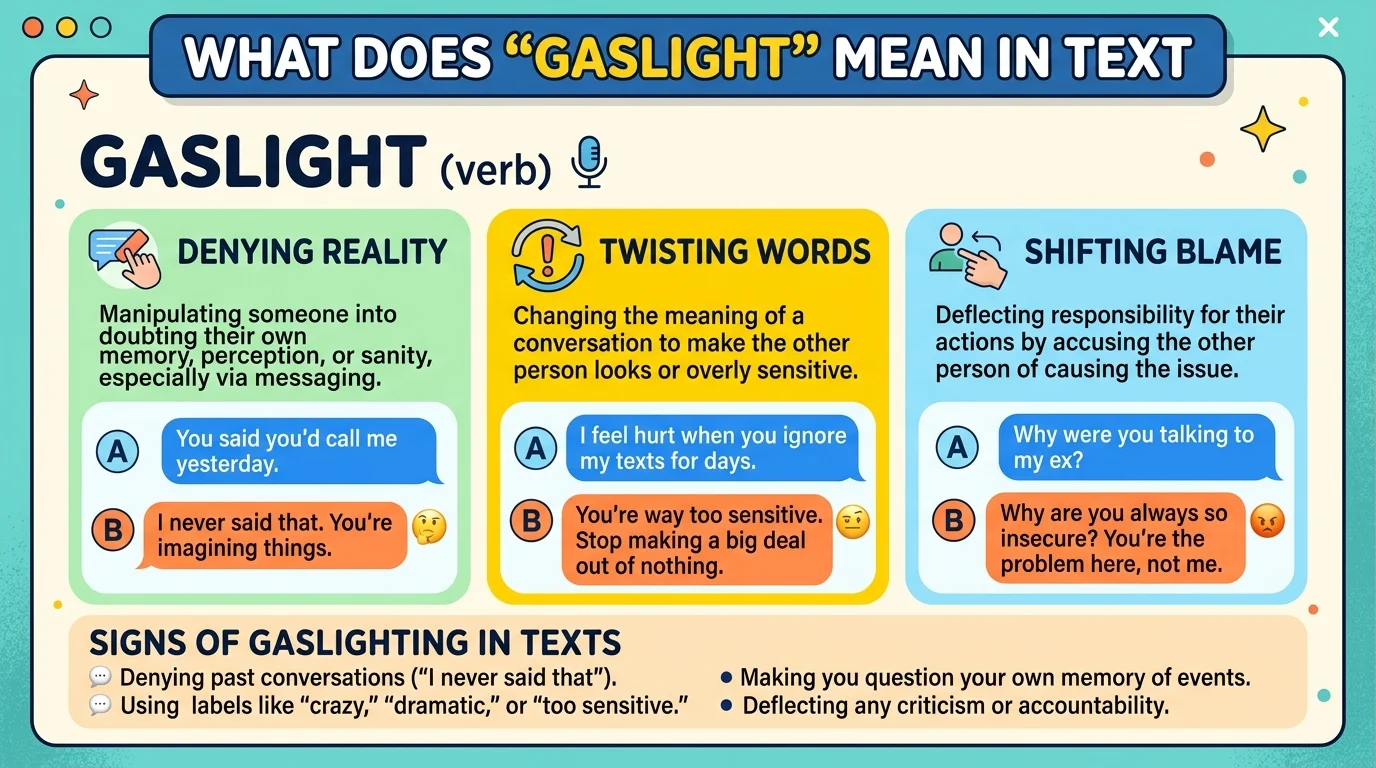
In texting and online conversations, “gaslight” means:
A form of emotional manipulation where someone makes another person question their memory, feelings, or perception of reality.
It is often used when someone feels mentally confused after a conversation.
Simple examples:
- “You’re imagining things, that never happened.”
- “I never said that, you’re overthinking.”
- “You’re too sensitive, it was just a joke.”
These phrases can feel like emotional distortion, which is why people call it “gaslighting.”
Origin & Background of the Word “Gaslight”
The term comes from a 1938 play called Gas Light, later adapted into films. In the story, a husband manipulates small details in his environment (like dimming gas lights) and then denies it to make his wife believe she is going in*ane.
Over time, psychologists adopted the term to describe emotional manipulation patterns.
With the rise of social media and texting culture, the word moved from psychology into everyday language. Now, it is widely used on platforms like TikTok, Instagram, and Twitter/X to describe confusing or manipulative communication.
However, the modern use is often broader—and sometimes incorrectly applied to normal disagreements.
Real-Life Conversations Using “Gaslight” (Text Examples)
1. WhatsApp Conversation
Person A: “You said you would call me last night.”
Person B: “No, I never said that. You’re imagining things.”
Person A: “Stop gaslighting me, I clearly remember it.”
2. Instagram DM
Person A: “Why did you ignore my story after replying?”
Person B: “I didn’t see it.”
Person A: “You literally saw it. Don’t gaslight me.”
3. TikTok Comment Thread
User 1: “This creator keeps changing their story.”
User 2: “Yeah, feels like they’re gaslighting the audience.”
4. Text Message Between Friends
Friend A: “You told me this was okay yesterday.”
Friend B: “I never said that.”
Friend A: “Why are you gaslighting me now?”
These examples show how the word is used emotionally in everyday digital communication.
Emotional & Psychological Meaning
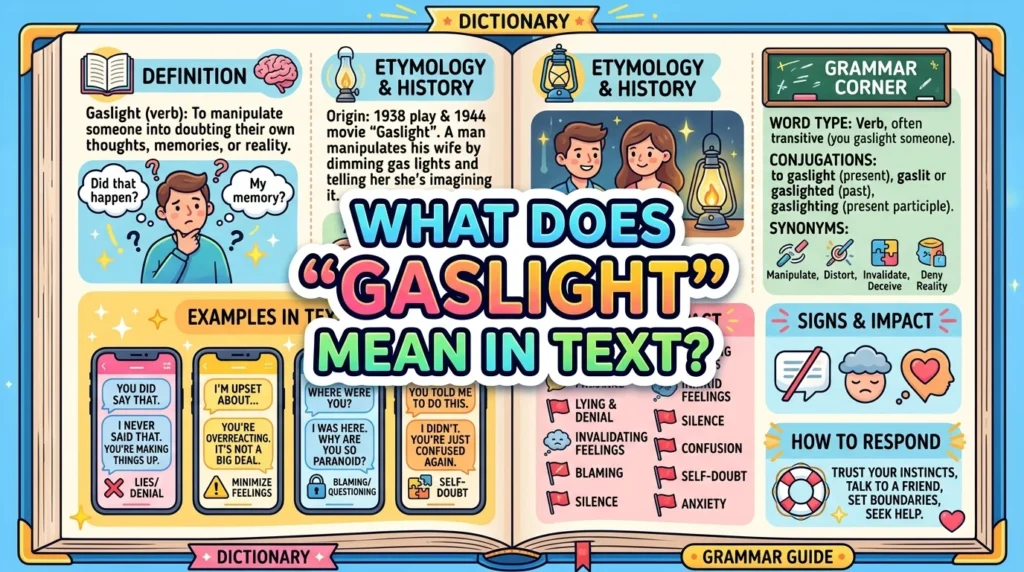
When people use the word “gaslight” in text, they are usually expressing:
- Confusion about a conversation
- Feeling emotionally invalidated
- Loss of trust in communication
- Frustration with denial or contradiction
In modern communication, texting removes tone of voice and facial expressions. Because of this, misunderstandings increase, and people may quickly label behavior as “gaslighting,” even when it is just miscommunication.
Real-world scenario
Imagine texting a friend about plans. You clearly remember agreeing to meet at 6 PM, but they insist it was 7 PM. After repeated denial, you start doubting yourself. That emotional confusion is where the word “gaslight” often comes into play.
Usage in Different Contexts
1. Social Media
Used to call out confusing or contradictory statements in posts or comments.
2. Friends & Relationships
Often used when someone feels emotionally dismissed or denied.
3. Work Environment
Used carefully when communication feels manipulative or unclear.
4. Casual Conversations
Sometimes used jokingly, even when real gaslighting is not happening.
When NOT to Use It
Using “gaslight” incorrectly can weaken its meaning. Avoid it when:
- It’s a simple misunderstanding
- Someone forgets something unintentionally
- There is no pattern of manipulation
- In professional formal communication without evidence
Using it too loosely can also lead to unnecessary conflict.
Common Misunderstandings
Many people confuse gaslighting with:
- Disagreement
- Forgetfulness
- Miscommunication
- Different memory of events
Not every denial is gaslighting. Real gaslighting involves repeated, intentional manipulation, not one-time confusion.
Another mistake is using it for sarcasm or jokes, which can dilute its serious psychological meaning.
Comparison Table
| Aspect | Gaslight Meaning | How It Is Used | Example Intent | Gaslight vs Manipulation |
|---|---|---|---|---|
| Definition | Emotional reality distortion | Used in texting conflicts | “You’re imagining things” | Gaslighting is a form of manipulation |
| Usage | Psychological + slang | Social media & chats | Calling out denial behavior | Manipulation is broader |
| Example | “That never happened” | Emotional disagreement | “You’re too sensitive” | Not all manipulation is gaslighting |
| Tone | Serious / emotional | Sometimes casual online | Feeling mentally confused | Gaslighting is more targeted |
Key Insight
Gaslighting is a specific emotional manipulation pattern, while manipulation is a broader behavior. In texting culture, people often use “gaslight” to describe emotional confusion, even when the situation is less severe.
Variations / Types in Text Language
1. Gaslight (in text)
Used to describe emotional denial in messages.
2. Gaslighting
Continuous manipulation over time.
3. You’re gaslighting me
Direct accusation in conversation.
4. Stop gaslighting
Request to stop emotional denial.
5. Gaslit
Past experience of being manipulated.
6. Gaslight behavior
Pattern of repeated denial.
7. Emotional gaslight
Highlighting emotional impact.
8. Online gaslight
Manipulation through digital communication.
9. Subtle gaslight
Hidden or soft manipulation in conversation.
10. Accidental gaslight (misused term)
Incorrect use when referring to misunderstanding.
How to Respond When Someone Uses “Gaslight”
Casual replies
- “I think we just misunderstood each other.”
- “Let’s clear this up calmly.”
Funny replies
- “I promise I’m not running a psychology experiment 😅”
- “No gaslights here, just bad memory!”
Mature replies
- “I understand why you feel that way, let’s talk it through.”
- “That wasn’t my intention, let’s clarify.”
Respectful replies
- “I hear you, I’ll be more careful with my words.”
- “Let’s make sure we’re both on the same page.”
Regional & Cultural Usage
Western culture
Common in psychology discussions and social media debates.
Asian culture
Increasingly used in younger digital communities, especially on TikTok and Instagram.
Middle Eastern culture
Used mostly among English-speaking youth online, still emerging in daily slang.
Global internet usage
Universal slang now, but meaning often varies in seriousness.
Gen Z vs Millennials
- Gen Z: More casual and frequent usage
- Millennials: More aware of psychological origin and seriousness
Is It Safe for Kids?
The word itself is not harmful, but it carries psychological weight. Children may misuse it in arguments without understanding its real meaning. It’s best explained in simple terms before using it in emotional contexts.
FAQs
1. What does gaslight mean in text?
It means emotionally manipulating someone into doubting their memory or reality.
2. Is gaslighting always intentional?
Yes, real gaslighting is usually intentional and repeated.
3. Can gaslight be used jokingly?
Yes, but it can dilute its serious meaning.
4. Is forgetting something gaslighting?
No, simple forgetfulness is not gaslighting.
5. Why do people use this word online?
To describe emotional confusion or denial in conversations.
6. Is gaslighting abuse?
Yes, in psychology it is considered emotional abuse when repeated.
Conclusion
Understanding what gaslight means in text helps you recognize emotional patterns in modern communication. It is not just a trending slang word but a term rooted in psychological manipulation. While people often use it casually in chats, its real meaning involves making someone doubt their memory or perception. In digital conversations, where tone and intent are easily misunderstood, the word has become common but sometimes misused. Knowing the difference between confusion, disagreement, and true gaslighting helps you respond more clearly and protect your emotional well-being in online interactions and real-life relationships.