
If you’ve come across the term “OMR” in text or online chats and felt confused, you’re not alone. Many people pause for a second, wondering if it’s slang, a shortcut, or something technical.
The truth is, OMR is not just one meaning. It can change depending on where you see it—whether in education, technology, business, or casual digital conversations.
Most commonly, OMR stands for Optical Mark Recognition, a technology used to read shaded bubbles on exam sheets and surveys. But in modern online communication, people sometimes use it in shortened or contextual ways that make it more confusing.
This article breaks everything down in a simple, human way so you can finally understand what OMR means, how it works, and why it appears in both academic and digital spaces.
OMR Meaning in Text – Quick Meaning
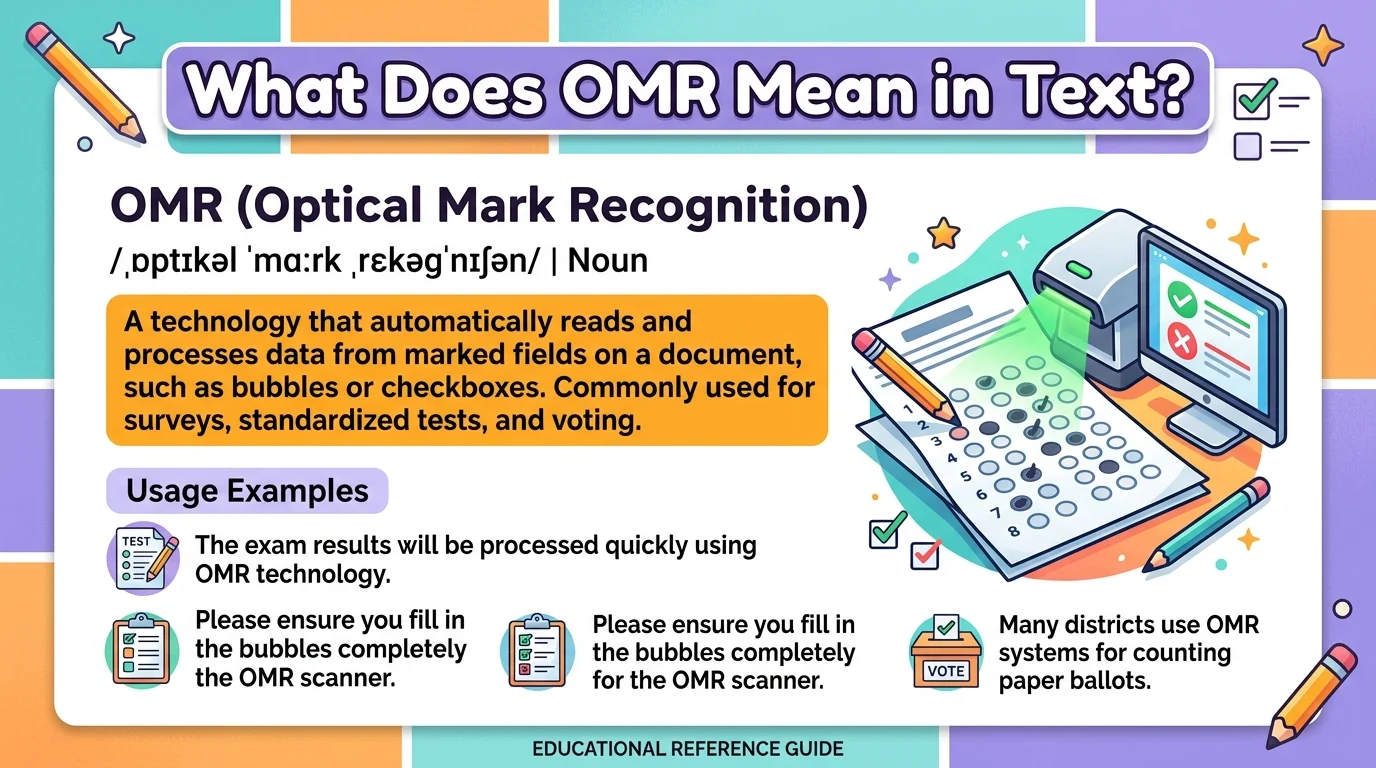
In most cases, OMR means Optical Mark Recognition, a system used to detect marked answers on printed forms.
Simple definition:
- A technology that reads shaded circles or checkboxes on paper
- Used in exams, surveys, and data collection
- Helps convert physical marks into digital results
Example meanings in context:
- “The results were processed using OMR sheets.”
- “We filled the OMR form for the exam today.”
- “Make sure the bubbles are dark enough for OMR scanning.”
So when someone says OMR in a text-related context, they are usually talking about exam sheets or scanning systems, not slang emotions or internet abbreviations.
Origin & Background of OMR
OMR technology has been around for decades, long before smartphones and social media.
It started in educational institutions where checking thousands of exam papers manually was slow and error-prone. Schools and testing boards needed a faster system, and that’s where OMR came in.
Over time:
- It became widely used in competitive exams
- Governments adopted it for census forms and surveys
- Businesses started using it for feedback sheets
Today, OMR is still relevant because it is simple, cost-effective, and highly accurate compared to manual checking.
In digital culture, however, people sometimes encounter the term and assume it is slang—leading to confusion online.
How does OMR work
OMR works on a surprisingly simple principle: detecting darkness or shading on paper.
Here’s a step-by-step explanation:
- A user fills bubbles on a printed sheet using a pen or pencil
- The sheet is scanned by an OMR scanner
- The scanner uses light sensors to detect dark marks
- Software interprets these marks as answers or selections
- Data is converted into digital format for evaluation
OMR=detectionofmarkedareasonpaperthroughlightreflectionanalysis
The key idea is simple:
Dark areas absorb light, while empty areas reflect it differently.
This contrast helps machines identify answers accurately within seconds.
OMR example
To understand it better, imagine a real exam scenario.
A student receives an answer sheet with multiple-choice questions:
- A: ●
- B: ○
- C: ○
- D: ○
If the student fills option A completely, the scanner recognizes it as the selected answer.
Real-life example:
In competitive exams like university entrance tests, thousands of students fill OMR sheets. Instead of teachers checking them manually, a machine scans everything in minutes.
This reduces human error and speeds up results significantly.
Uses of OMR in computer
OMR is closely connected to computer systems because it depends on digital processing.
Major uses include:
- Processing exam answer sheets
- Conducting online-to-offline surveys
- Collecting feedback forms
- Processing voting ballots in some systems
- Data entry automation
In computing terms, OMR is part of input automation systems that reduce manual work and improve efficiency.
Optical Mark Recognition
Optical Mark Recognition (OMR) is the full form of OMR and the core concept behind the technology.
It focuses on detecting:
- Filled bubbles
- Tick marks
- Shaded boxes
Unlike OCR (Optical Character Recognition), which reads text, OMR only reads marks and selections.
Key difference:
- OCR = reads letters and words
- OMR = reads shaded marks only
This makes OMR faster but limited in scope.
OMR scanner
An OMR scanner is a specialized device used to read filled forms.
It looks similar to a regular document scanner but is designed for precision.
How it works:
- Sheet is fed into the scanner
- Light sensors detect shaded areas
- Software calculates responses
- Results are displayed digitally
OMR scanners are widely used in:
- Schools and universities
- Government exam centers
- Research organizations
They are built for speed and accuracy, handling thousands of sheets in a short time.
OMR meaning in business
In business environments, OMR is used for data collection and analysis.
Companies use OMR sheets for:
- Customer feedback surveys
- Employee evaluation forms
- Market research questionnaires
- Event registration forms
Instead of manually entering data, businesses rely on OMR systems to:
- Save time
- Reduce human error
- Process large datasets quickly
This makes OMR a silent but powerful tool in decision-making processes.
OMR software
OMR software is the digital brain behind the entire system.
It interprets scanned data and converts it into usable information.
Key features:
- Auto detection of marked answers
- Error correction tools
- Instant result generation
- Data export to Excel or databases
Modern OMR software is now integrated with AI-based systems, making it even more accurate and flexible than older versions.
OMR machine
An OMR machine is the complete setup that includes:
- Scanner hardware
- Processing software
- Data output system
What it does:
- Reads marked sheets
- Processes large volumes of data
- Generates reports instantly
OMR machines are widely used in:
- Competitive exams
- National surveys
- Educational testing centers
They have become essential in systems where speed and accuracy matter.
Real-Life Conversations (MANDATORY)
WhatsApp Conversation:
Person A: “Bro, what is OMR in exam forms?”
Person B: “It’s that sheet where you fill bubbles. Machine reads it automatically.”
Instagram DM:
Person A: “I keep hearing OMR everywhere 😭 what is it?”
Person B: “It’s just Optical Mark Recognition… basically scanning answer sheets.”
TikTok Comment:
Person A: “OMR sounds like slang lol”
Person B: “Nope 😂 it’s actually exam technology, not internet slang.”
Text Message:
Person A: “Did you submit OMR sheet?”
Person B: “Yes, just filled all bubbles carefully.”
Emotional & Psychological Meaning
OMR might look technical, but psychologically it represents structure, fairness, and automation.
People trust OMR systems because:
- They reduce human bias
- They feel more objective
- They provide quick results
In real-life scenarios, students often feel anxious while filling OMR sheets because a small mistake can change results. That emotional pressure shows how important precision becomes in modern systems.
Example scenario:
A student preparing for a competitive exam double-checks every bubble before submission, knowing that even a light mark could affect their future.
Usage in Different Contexts
Social media:
Used in educational explanations or memes about exams
Friends & relationships:
Rare, but may appear in academic discussions
Work / professional:
Used in surveys, HR forms, and data collection
Casual vs serious tone:
- Casual: “I messed up my OMR sheet 😭”
- Serious: “OMR processing improved exam efficiency significantly”
When NOT to Use It
Avoid using OMR:
- In emotional or personal texting contexts
- As slang in casual chats (it confuses people)
- When referring to feelings or expressions
It is a technical term, not an emotional abbreviation.
Common Misunderstandings
Many people think:
- OMR is internet slang
- OMR is similar to OCR
- OMR reads handwriting
But in reality:
- It only reads marks
- It is not slang
- It does not interpret words
This confusion usually comes from seeing the abbreviation without context.
Comparison Table
| Concept | Meaning Intent | Usage Intent | Example Intent | Comparison Intent |
|---|---|---|---|---|
| What does OMR mean | Optical Mark Recognition system | Explains definition | “OMR is used in exams” | Compared to OCR |
| How to use OMR | Filling bubble sheets correctly | Practical usage | Marking answers properly | Vs manual checking |
| Examples of OMR | Real-life usage cases | Educational & exam usage | Exam sheets, surveys | Vs digital forms |
| OMR vs OCR | Difference in technology | Reading marks vs text | OMR reads bubbles | OCR reads words |
Key Insight:
OMR is not just a tool—it is a bridge between paper-based input and digital evaluation systems, making large-scale assessments faster and more reliable.
Variations / Types (10)
- OMR meaning – Optical Mark Recognition definition
- OMR in text – technical abbreviation in chats
- OMR abbreviation – short form of scanning system
- OMR slang – rarely used incorrectly as slang
- OMR in chat – usually academic explanation
- OMR sheet – answer sheet used in exams
- OMR scanner meaning – device that reads marks
- OMR software meaning – program that processes scans
- OMR machine meaning – full scanning system
- OMR system meaning – complete technology setup
How to Respond When Someone Uses It
Casual replies:
- “It’s just exam scanning tech 😄”
Funny replies:
- “Not slang bro, your marks depend on it 😂”
Mature replies:
- “It stands for Optical Mark Recognition used in exams.”
Respectful replies:
- “It’s a system that reads shaded answers on forms.”
Regional & Cultural Usage
- Western culture: Used in standardized testing systems
- Asian culture: Common in competitive exams
- Middle Eastern culture: Used in academic evaluations
- Global internet usage: Mostly educational explanation
- Gen Z vs Millennials:
- Gen Z sees it in exam memes
- Millennials recognize it from school systems
Is It Safe for Kids?
Yes, OMR is completely safe.
It is simply a technical system used in education, with no harmful or sensitive meaning.
FAQs
What does OMR stand for?
OMR stands for Optical Mark Recognition, a technology used to detect shaded bubbles or marks on paper forms, especially in exams and surveys.
What is the full form of OMR in WhatsApp?
In WhatsApp or chat context, OMR still means Optical Mark Recognition. It is not slang; it usually appears in academic or exam-related conversations.
What does OQ mean in slang?
In slang or texting, OQ is not widely standardized, but it is sometimes used as a shortened or typo variation in casual chats. Its meaning depends heavily on context and is often unclear without the full sentence.
What does OTR mean in text slang?
OTR commonly means “On The Road” or “Off The Record” depending on context. In chats, it is used to show someone is traveling or speaking informally.
What does OMR mean in text messages?
In text messages, OMR usually refers to Optical Mark Recognition, especially when talking about exams, answer sheets, or scanning forms.
Is OMR a slang word?
No, OMR is not slang. It is a technical term used in education, testing systems, and data processing.
Where is OMR commonly used?
OMR is commonly used in exams, surveys, voting forms, and data collection systems where multiple-choice answers are marked.
Is OMR and OCR the same?
No. OMR reads marks, while OCR (Optical Character Recognition) reads printed or handwritten text.
Can OMR read handwriting?
No, OMR cannot read handwriting. It only detects filled bubbles or shaded marks on a form.
Why is OMR important in exams?
OMR is important because it allows fast, accurate, and unbiased checking of thousands of answer sheets within minutes.
Conclusion
OMR is more than just an abbreviation; it is a reliable system that quietly powers exams, surveys, and large-scale data collection around the world. While it may appear confusing in text at first, its meaning becomes clear once you understand its purpose. From classrooms to business forms, OMR ensures accuracy and speed in decision-making. Knowing it helps you avoid confusion and understand modern assessment systems with confidence and clarity in everyday academic and professional situations.