
If you spend time on TikTok, Instagram, Snapchat, or texting friends late at night, chances are you’ve seen someone type “idek” in the middle of a conversation.
Maybe a friend replied:
“idek anymore 😭”
Or someone commented:
“idek why this made me emotional.”
At first glance, it looks confusing. Is it a typo? A code? A new slang trend?
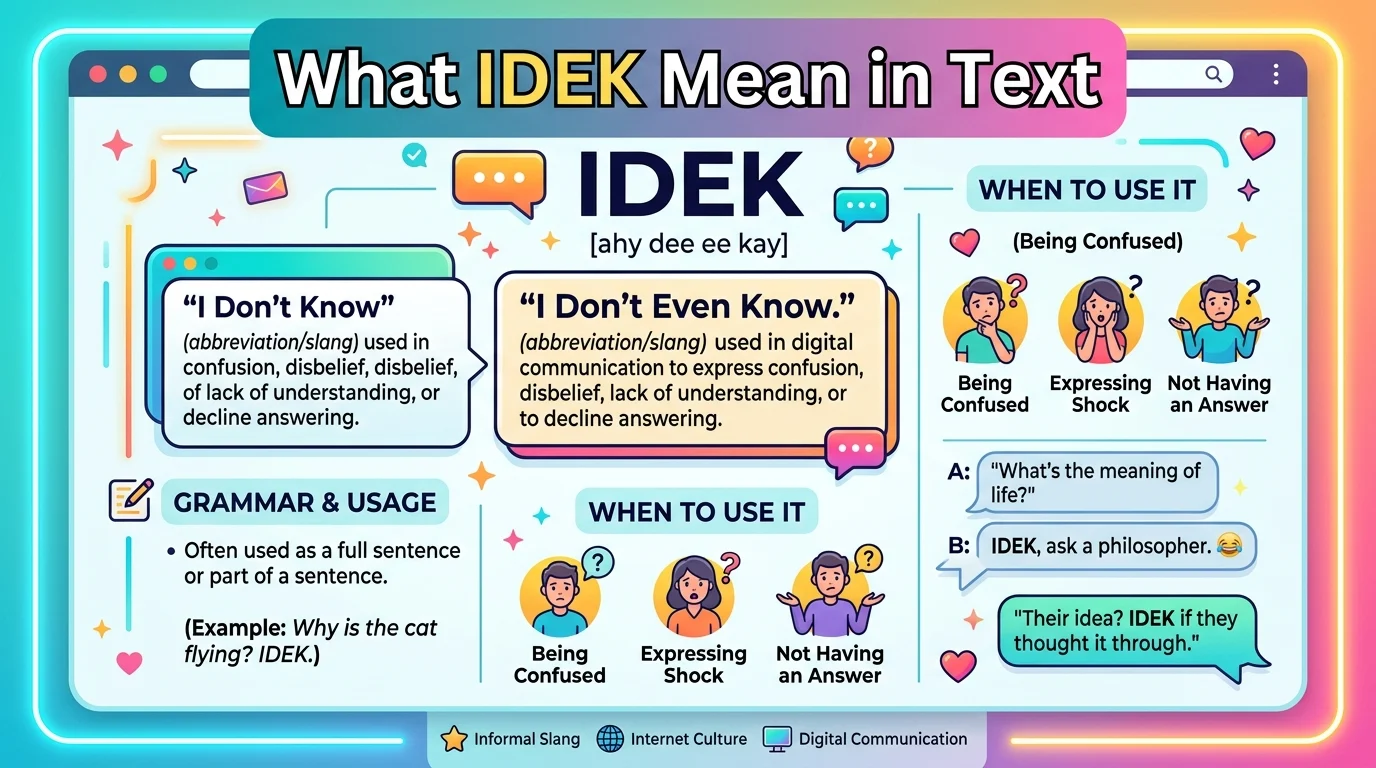
The truth is simple: “idek” is one of the most common emotional texting abbreviations used online today. People use it when they feel confused, overwhelmed, unsure, shocked, awkward, or emotionally exhausted.
That’s why so many people search for what idek mean in text. They want to understand not only the definition, but also the tone behind it. In modern digital conversations, tone matters just as much as words.
This guide explains the meaning of “idek,” where it came from, how people actually use it, and why it became such a powerful part of internet communication.
What IDEK Mean in Text – Quick Meaning
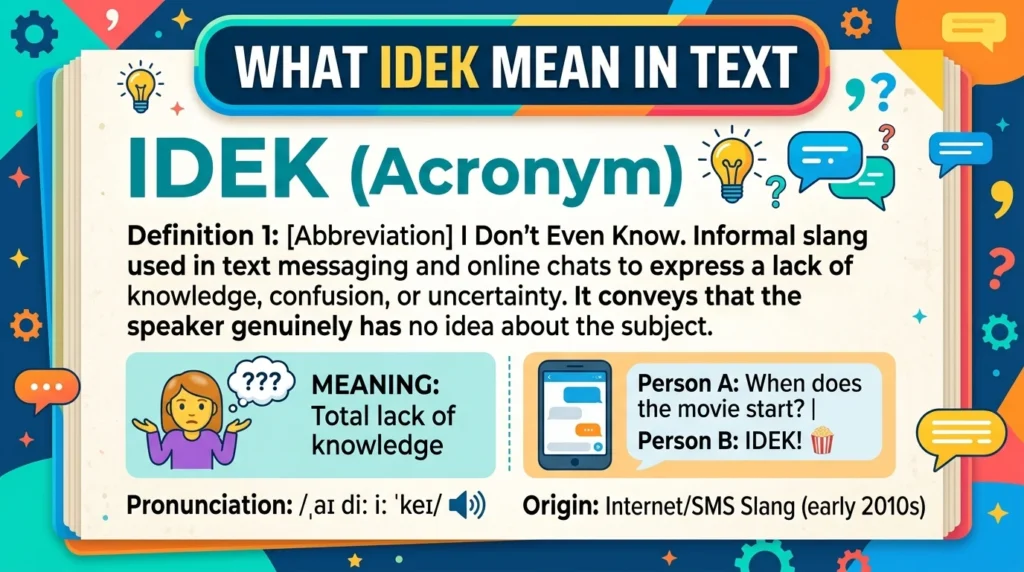
“IDEK” stands for:
“I Don’t Even Know.”
People use it when they:
- Feel confused
- Cannot explain something
- Are emotionally overwhelmed
- Don’t know how to react
- Want to sound casual or expressive
It’s usually written in lowercase:
- idek
But sometimes people use uppercase for stronger emotion:
- IDEK
Simple Examples
“idek what happened last night.”
“I asked him why he was acting weird and he said idek.”
“idek why this song makes me cry.”
The phrase often carries emotion beyond the literal meaning. Sometimes it means:
- “I’m tired.”
- “I’m frustrated.”
- “I’m speechless.”
- “I’ve given up trying to explain.”
That emotional flexibility is why the slang became so popular online.
Origin & Background
“IDEK” grew from early internet texting culture during the late 2000s and early 2010s.
As smartphones became common, people started shortening phrases to type faster:
- IDK = I don’t know
- TBH = To be honest
- IMO = In my opinion
Eventually, users added emotional intensity to “IDK” by turning it into “IDEK” — “I don’t even know.”
The word “even” changed the feeling completely.
Instead of simple uncertainty, “idek” started expressing:
- emotional confusion
- disbelief
- exhaustion
- dramatic reactions
Social media accelerated its popularity. Platforms like:
- Twitter/X
- TikTok
- Tumblr
- Snapchat
helped turn “idek” into a relatable emotional phrase.
Memes and reaction culture also played a huge role. Online users often communicate feelings indirectly, and “idek” became perfect for expressing complicated emotions without writing long explanations.
Over time, the phrase evolved from simple slang into a kind of emotional shorthand.
Real-Life Conversations
WhatsApp Conversation
Person A:
“Are you still talking to him?”
Person B:
“idek honestly… things feel weird now.”
Instagram DM
Person A:
“Why were you crying on your story?”
Person B:
“idek 😭 it’s been a stressful week.”
TikTok Comments
Person A:
“This scene destroyed me emotionally.”
Person B:
“idek how people watched this without crying.”
Text Message
Person A:
“What do you want to do after graduation?”
Person B:
“idek anymore. everything changed this year.”
These examples show how “idek” often carries emotion, uncertainty, or emotional fatigue — not just lack of information.
Emotional & Psychological Meaning
One reason “idek” became so popular is because modern communication is deeply emotional but incredibly fast.
People don’t always want to explain everything they feel.
Sometimes they:
- feel mentally overloaded
- cannot organize their thoughts
- want emotional support without asking directly
- use humor to hide stress
That’s where “idek” becomes useful.
It creates emotional openness without requiring vulnerability.
For example, someone might say:
“idek what I’m doing with my life.”
They may not literally mean they know nothing. Instead, they may feel:
- anxious
- uncertain
- emotionally lost
- overwhelmed by pressure
In many cases, “idek” acts like a soft emotional shield.
Personal-Style Scenario
A university student staying awake at 2 AM while scrolling TikTok might text:
“idek if I’m tired, stressed, or just done.”
That sentence feels real because it reflects modern emotional exhaustion. Many people use “idek” during moments where emotions are difficult to fully explain.
Usage in Different Contexts
Social Media
On TikTok, Instagram, and X, “idek” is often dramatic, funny, or emotional.
Examples:
- “idek why this meme is so funny.”
- “idek how I survived this week.”
It helps posts sound authentic and relatable.
Friends & Relationships
Among friends, “idek” creates casual emotional honesty.
Examples:
- “idek what to wear.”
- “idek if she likes me.”
In relationships, it may signal confusion or emotional uncertainty.
Work or Professional Settings
Using “idek” professionally is risky.
Avoid writing:
- “idek what happened.”
- “idek how to fix this.”
in:
- work emails
- formal meetings
- client communication
It may sound immature or careless.
Casual vs Serious Tone
Casual use:
“idek what movie to watch.”
Serious emotional use:
“idek who I am anymore.”
Tone depends heavily on context and emotion.
When NOT to Use It
Although common online, “idek” does not fit every situation.
Avoid using it:
- in job interviews
- in academic writing
- in formal business communication
- during serious legal or medical discussions
It can also create misunderstandings when someone expects a clear answer.
For example:
Person A:
“Did you complete the important task?”
Person B:
“idek.”
This may sound dismissive or irresponsible.
Cultural sensitivity matters too. In some cultures, direct communication is valued more than emotional slang.
Common Misunderstandings
Many people think “idek” only means:
“I don’t know.”
But emotionally, it often means much more.
Common Confusions
| Misunderstanding | Reality |
|---|---|
| It always means confusion | Sometimes it means emotional overload |
| It’s rude | Usually casual, not offensive |
| It’s only Gen Z slang | Millennials use it too |
| It means ignorance | Often it expresses emotion instead |
| It’s always funny | Sometimes deeply serious |
Literal meaning and emotional meaning are often different online.
Comparison Table
| Phrase | Meaning | Intent |
|---|---|---|
| What Does IDEK Mean | “I don’t even know” | Definition intent |
| How to Use IDEK | Casual emotional texting | Usage intent |
| Examples of IDEK | Real chat expressions | Example intent |
| IDEK vs IDK | Stronger emotional version | Comparison intent |
| IDEK vs IDC | Confused vs not caring | Emotional difference |
| IDEK in Text | Internet shorthand | Messaging intent |
Key Insight
“IDEK” is not just an abbreviation. It reflects how modern people communicate emotions quickly, casually, and indirectly in digital spaces.
Variations / Types
IDEK meaning
Means “I don’t even know.”
IDEK in text
Used in texting to express confusion or emotional overwhelm.
IDEK abbreviation
Short internet abbreviation for fast communication.
IDEK slang
Modern online slang popular with Gen Z and Millennials.
IDEK in chat
Common in DMs, gaming chats, and casual conversations.
IDEK anymore meaning
Expresses emotional exhaustion or frustration.
IDEK bro meaning
Adds humor or emotional disbelief between friends.
IDEK lol meaning
Softens confusion with humor.
IDEK what to do meaning
Shows uncertainty or emotional stress.
IDEK why meaning
Expresses confusion about feelings or reactions.
How to Respond When Someone Uses It
Casual Replies
- “Same honestly.”
- “I get that.”
- “That’s understandable.”
Funny Replies
- “Welcome to the club 😂”
- “Nobody knows anymore.”
- “We’re all confused together.”
Mature Replies
- “Take your time figuring it out.”
- “You don’t need all the answers immediately.”
Respectful Replies
- “I’m here if you want to talk.”
- “That sounds overwhelming.”
Your response should match the emotional tone behind the message.
Regional & Cultural Usage
Western Culture
In the US, UK, and Canada, “idek” is extremely common in casual texting and meme culture.
It often sounds emotionally expressive and relatable.
Asian Culture
In many Asian countries, younger users understand “idek” through global internet culture, especially TikTok and gaming communities.
However, formal communication still tends to avoid slang abbreviations.
Middle Eastern Culture
Young internet users often mix English slang like “idek” into bilingual conversations.
It is especially popular in:
- online gaming
- social media comments
- private chats
Global Internet Usage
The phrase became global because internet culture itself became global.
Memes, reaction videos, and short-form content helped slang spread across countries rapidly.
Generational Differences
Gen Z
Uses “idek” emotionally and dramatically.
Example:
“idek how I survived this semester.”
Millennials
Usually use it more casually or sarcastically.
Example:
“idek where I left my keys again.”
Is It Safe for Kids?
Generally, yes.
“IDEK” is not considered offensive or dangerous slang.
However, parents should still understand context. Sometimes children or teenagers use it while expressing:
- stress
- anxiety
- emotional confusion
The phrase itself is harmless, but emotional conversations around it may deserve attention and support.
FAQs
What does IDEK mean in texting?
IDEK means “I don’t even know.” It expresses confusion, uncertainty, or emotional overwhelm.
Is IDEK rude?
Usually no. It is casual internet slang and normally sounds informal rather than disrespectful.
What is the difference between IDK and IDEK?
IDK simply means “I don’t know,” while IDEK adds stronger emotion or frustration.
Do adults use IDEK?
Yes. Although common among Gen Z, many Millennials and adults use it in casual texting.
Can IDEK be serious?
Yes. Sometimes people use it humorously, but it can also reflect genuine emotional stress or confusion.
Is IDEK formal English?
No. It is informal internet slang and should not be used in professional writing.
Why is IDEK so popular online?
Because it quickly expresses complicated emotions in a relatable and natural way.
Conclusion
Language online keeps evolving, and “idek” is a perfect example of how modern communication blends emotion, speed, and personality into just a few letters. What started as simple internet shorthand now reflects confusion, stress, humor, uncertainty, and emotional honesty all at once. Understanding what idek mean in text helps you read conversations more naturally and respond with the right tone. Whether you use it jokingly or seriously, knowing its emotional context makes digital communication feel far more human and connected.