
If you’ve spent any time on TikTok, Instagram, Snapchat, or texting apps, you’ve probably seen the skull emoji (💀) appear in conversations. At first glance, it looks dark, serious, or even scary. After all, a skull traditionally represents death.
But online communication has completely transformed its meaning.
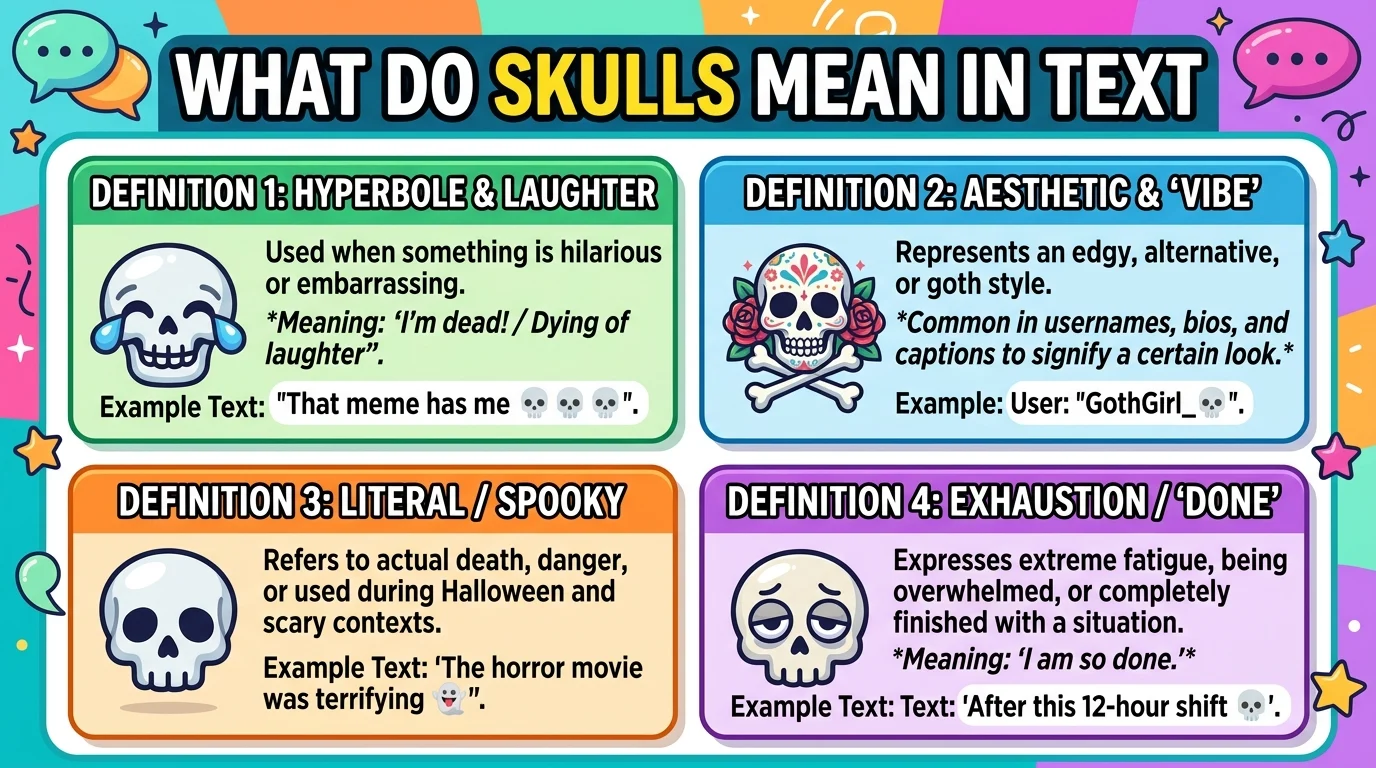
Today, many people use the skull emoji to express extreme laughter, embarrassment, shock, or emotional overwhelm. It has become one of the most popular symbols in digital conversations, especially among Gen Z users.
People search “what do skulls mean in text” because the emoji often appears in situations where its meaning isn’t obvious. Is someone upset? Are they joking? Are they being sarcastic?
This guide explains exactly what the skull emoji means, how different people use it, and how you can understand it confidently in modern conversations.
What Do Skulls Mean in Text – Quick Meaning
In most online conversations, the skull emoji (💀) means:
- “I’m laughing so hard.”
- “That was hilarious.”
- “I’m dead from laughter.”
- “I’m shocked.”
- “I’m embarrassed.”
The emoji rarely refers to actual death.
Instead, it symbolizes being emotionally overwhelmed by something funny, awkward, ridiculous, or unexpected.
Examples:
“You really said that in front of everyone 💀”
“That video has me crying 💀”
“I can’t believe I just did that 💀”
In simple terms, the skull emoji often means someone finds a situation so funny or unbelievable that they feel “dead” from laughter.
Origin & Background
The modern skull emoji meaning developed through internet culture.
Years ago, people commonly used phrases such as:
- “I’m dead.”
- “That killed me.”
- “I’m dying laughing.”
As social media evolved, users began replacing those phrases with a single emoji: 💀.
Platforms like TikTok, Instagram, Twitter, Snapchat, and Discord helped popularize this usage.
Gen Z particularly embraced the skull emoji because it feels more expressive than a standard laughing emoji.
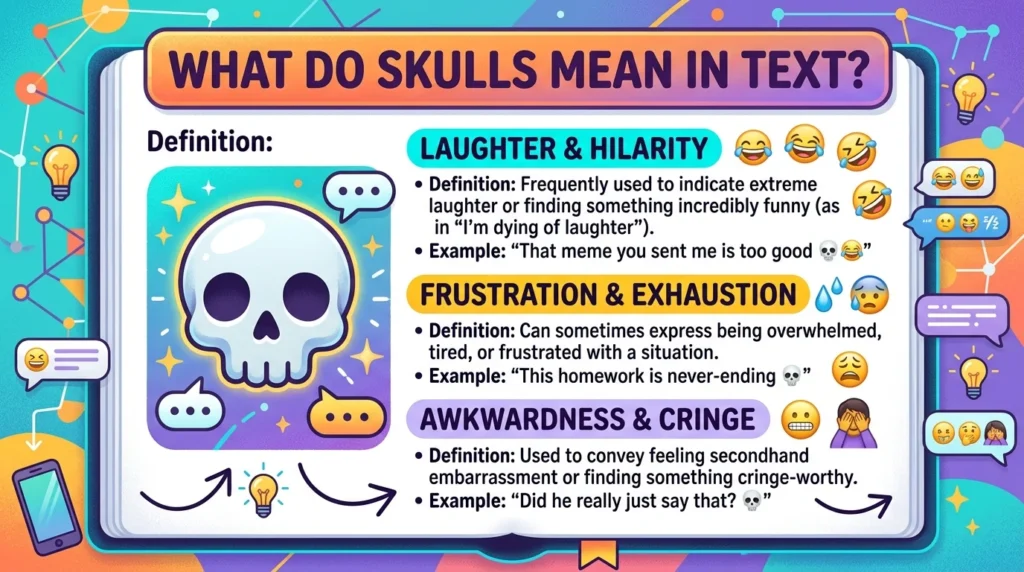
Over time, the meaning expanded beyond laughter. Today it can also communicate:
- Second-hand embarrassment
- Shock
- Cringe
- Emotional overload
- Playful sarcasm
The result is an emoji that carries multiple emotional layers depending on context.
What Do Skulls Mean in Text From Girl
When a girl sends 💀, it usually indicates strong emotional reaction rather than negativity.
Common meanings include:
- Something is extremely funny.
- She feels embarrassed.
- She is teasing playfully.
- She cannot believe what happened.
Example:
Girl:
“I just waved back at someone who wasn’t waving at me 💀”
Meaning:
She feels embarrassed and is laughing at herself.
In many cases, the emoji softens the message and makes the conversation feel more playful.
What Do Skulls Mean in Text From a Guy
Guys often use the skull emoji in similar ways but may lean more heavily toward humor and sarcasm.
Common meanings:
- That joke was hilarious.
- That’s ridiculous.
- I’m shocked.
- I’m making fun of the situation.
Example:
Guy:
“Bro forgot his own birthday 💀”
Meaning:
He finds the situation absurdly funny.
The tone is usually lighthearted rather than serious.
What Does the Skull Emoji Mean From a Girl
The meaning depends on the surrounding message.
A girl might use 💀 to:
- Show she is laughing hard.
- Express awkwardness.
- React to something unexpected.
- Signal playful flirting.
Example:
“You really thought that would work? 💀”
The emoji often makes criticism sound teasing instead of harsh.
Understanding her overall tone matters more than focusing on the emoji alone.
Skull Emoji Text
In texting culture, the skull emoji has become shorthand for emotional exaggeration.
Rather than typing:
“I’m laughing so hard.”
Someone simply writes:
“💀”
It works as a quick emotional reaction that instantly communicates amusement, shock, or disbelief.
This simplicity explains why it appears so frequently across messaging platforms.
💀 Meaning in Text From a Girl
When used by a girl, 💀 often signals:
- Genuine laughter
- Friendly teasing
- Shared humor
- Self-deprecating embarrassment
Example:
“I sent the message to my boss instead of my friend 💀”
The emoji suggests she recognizes the mistake and is laughing about it.
It rarely indicates anger or hostility.
What Does the Skull Emoji Mean From a Guy
Guys often use the skull emoji to amplify jokes.
Example:
“You spent three hours getting ready and still missed the event 💀”
The emoji communicates:
- Humor
- Mock disbelief
- Friendly roasting
It’s often part of casual banter among friends.
💀 Meaning in Text From a Guy
A guy may use 💀 when he wants to react strongly without writing a long message.
Examples:
- “That’s wild 💀”
- “No way 💀”
- “I’m done 💀”
The emoji acts like a shortcut for emotional expression.
Its exact meaning depends on the conversation.
😭 💀 Meaning in Text
When someone combines 😭 and 💀, the emotional intensity increases.
😭 = Crying
💀 = Dead from laughter
Together:
😭💀
Usually means:
“I’m laughing so hard that I’m crying.”
Example:
“That comment section is ins*ne 😭💀”
The combination is extremely common on TikTok and Instagram.
It signals maximum amusement.
Real-Life Conversations
WhatsApp Conversation
Person A:
“I accidentally called my teacher mom.”
Person B:
“NO WAY 💀”
Instagram DM
Person A:
“He liked my story from 2022.”
Person B:
“That’s actually cr*zy 💀”
TikTok Comments
Person A:
“Why is the cat walking like that?”
Person B:
“I can’t stop laughing 💀”
Text Message
Person A:
“I showed up a day early for the wedding.”
Person B:
“Please tell me you’re joking 💀”
These examples show how the emoji usually reflects humor rather than negativity.
Emotional & Psychological Meaning
The skull emoji reflects a growing trend in digital communication.
People increasingly use exaggerated symbols to express emotions quickly.
Instead of writing long explanations, one emoji can communicate:
- Laughter
- Shock
- Embarrassment
- Disbelief
A common scenario might look like this:
Imagine sending a message to the wrong group chat.
Your friend replies with:
“💀”
That single emoji instantly communicates understanding, humor, and emotional connection.
It creates shared laughter without requiring a lengthy response.
Usage in Different Contexts
Social Media
Often used in comments, captions, and reactions.
Example:
“That ending had me 💀”
Friends and Relationships
Creates playful conversation.
Example:
“You forgot our plans again 💀”
Work or Professional Settings
Generally not recommended.
Many professionals may misunderstand the emoji’s intended meaning.
Casual vs Serious Tone
Casual:
Appropriate and common.
Serious:
May appear insensitive during emotional discussions.
Always consider context before using it.
When NOT to Use It
Avoid using the skull emoji when discussing:
- Real deaths
- Medical emergencies
- Serious personal struggles
- Professional complaints
- Formal business communication
Because the emoji is strongly associated with humor online, it may unintentionally appear disrespectful.
Common Misunderstandings
Many people assume the skull emoji means:
- Death
- Threats
- Violence
- Depression
In most modern conversations, that’s incorrect.
The biggest misunderstanding comes from generational differences.
Older users may interpret the emoji literally, while younger users often see it as laughter.
Context remains essential.
Comparison Table
| Search Term | Meaning |
|---|---|
| What Does Skull Emoji Mean | Understanding the emoji’s intent |
| How to Use Skull Emoji | Learning proper usage |
| Examples of Skull Emoji | Real conversation examples |
| Skull Emoji vs 😂 | 💀 often signals stronger or more modern humor |
| Skull Emoji vs 😭 | 😭 focuses on crying; 💀 focuses on being overwhelmed |
| Skull Emoji vs 🤣 | 🤣 is direct laughter; 💀 can include shock and embarrassment |
Key Insight
The skull emoji is less about death and more about emotional exaggeration. Most users employ it to express intense laughter, disbelief, or embarrassment in a playful way.
Variations / Types
Skull emoji meaning
Represents intense laughter, shock, or emotional overload.
Skull emoji in text
Used as a reaction to something funny or unbelievable.
Skull emoji abbreviation
Often replaces phrases like “I’m dead.”
Skull emoji slang
Internet slang for being overwhelmed by humor.
Skull emoji in chat
Acts as a quick emotional response.
💀 meaning
Usually means “dead from laughter.”
💀 in social media
Popular reaction emoji on TikTok and Instagram.
💀 in comments
Expresses amusement or disbelief.
💀 in messaging
Adds humor to conversations.
💀 internet culture meaning
Symbolizes exaggerated emotional reaction.
How to Respond When Someone Uses It
Casual Replies
- “I know, right?”
- “That was wild.”
- “I couldn’t believe it either.”
Funny Replies
- “Rest in peace then.”
- “The joke got you too.”
- “You survived somehow.”
Mature Replies
- “It was definitely unexpected.”
- “I can see why that’s funny.”
Respectful Replies
- “I understand your reaction.”
- “That situation was quite surprising.”
Regional & Cultural Usage
Western Culture
Most commonly means extreme laughter or disbelief.
Asian Culture
Often follows global social media trends but may vary slightly by platform.
Middle Eastern Culture
Younger users frequently adopt the same humorous meaning seen worldwide.
Global Internet Usage
The emoji has become nearly universal as a symbol of exaggerated reaction.
Generational Differences
Gen Z:
Uses 💀 regularly for humor.
Millennials:
Understand it but may use 😂 more often.
Older generations:
May interpret it literally.
Is It Safe for Kids?
Generally, yes.
The skull emoji is commonly used as humor among young people.
Parents should still understand context because online slang changes quickly, but the emoji itself is usually harmless and playful.
FAQs
What does 💀 mean in texting?
In texting, 💀 usually means “I’m dead from laughter.” It is used when something is extremely funny, shocking, or embarrassing in a humorous way rather than referring to actual death.
What does the 💀 mean Gen Z?
For Gen Z, 💀 is a reaction emoji used to show intense laughter, disbelief, or second-hand embarrassment. It often replaces phrases like “I’m dying” or “that’s so funny.”
What does ☠ mean in texting?
The ☠ emoji (skull and crossbones) is less common in casual texting. It can mean danger, something toxic, or extreme situations, but in memes it is sometimes used similarly to 💀 for humor.
What does a skull mean in a text message?
A skull in a text message generally represents strong emotional reactions like laughter, shock, or embarrassment. It is rarely used in a literal sense of death.
Is the skull emoji rude in texting?
No, the skull emoji is usually not rude. However, in serious or emotional conversations, it can feel inappropriate because it may appear to make light of the situation.
Can 💀 be used in serious conversations?
It is not recommended. Using 💀 in serious discussions can cause misunderstanding because it is strongly associated with humor and exaggeration online.
Why do people use 💀 instead of 😂?
People use 💀 because it feels more intense and expressive than 😂. It shows that something is not just funny but extremely funny or unbelievable.
What does 💀 mean in TikTok comments?
On TikTok, 💀 is commonly used to react to funny, awkward, or shocking videos. It often replaces phrases like “I can’t stop laughing.”
Does 💀 always mean laughing?
No, while it mostly means laughter, it can also express shock, embarrassment, or disbelief depending on the context of the conversation.
What is the difference between 💀 and 😭 in texting?
💀 usually means “dead from laughter,” while 😭 means crying. When combined, they express extremely strong emotions, often laughing so hard that someone is crying.
Conclusion
The skull emoji has evolved far beyond its original association with death. In today’s digital conversations, it usually represents laughter, disbelief, embarrassment, or emotional overload. Whether it appears in a text message, TikTok comment, Instagram DM, or group chat, its purpose is often to add personality and emotion to communication. Understanding the context behind 💀 makes online conversations easier to follow and helps you respond naturally. Once you recognize its modern meaning, you’ll see why it remains one of the internet’s favorite reaction emojis.